01Area of inquiry
Physiological Intelligence
Exploring measurable physiological signals associated with attention, cognitive workload, and fatigue.
Synapique Labs · Early-stage research venture
Exploring intelligent neurotechnology designed to respond to the individual.
Synapique Labs is an early-stage neuroscience and neurotechnology venture investigating noninvasive approaches to cognitive performance.
We're exploring how physiological sensing, personalized sensory stimulation, and adaptive systems might inform the next generation of human-centered wearable technology.
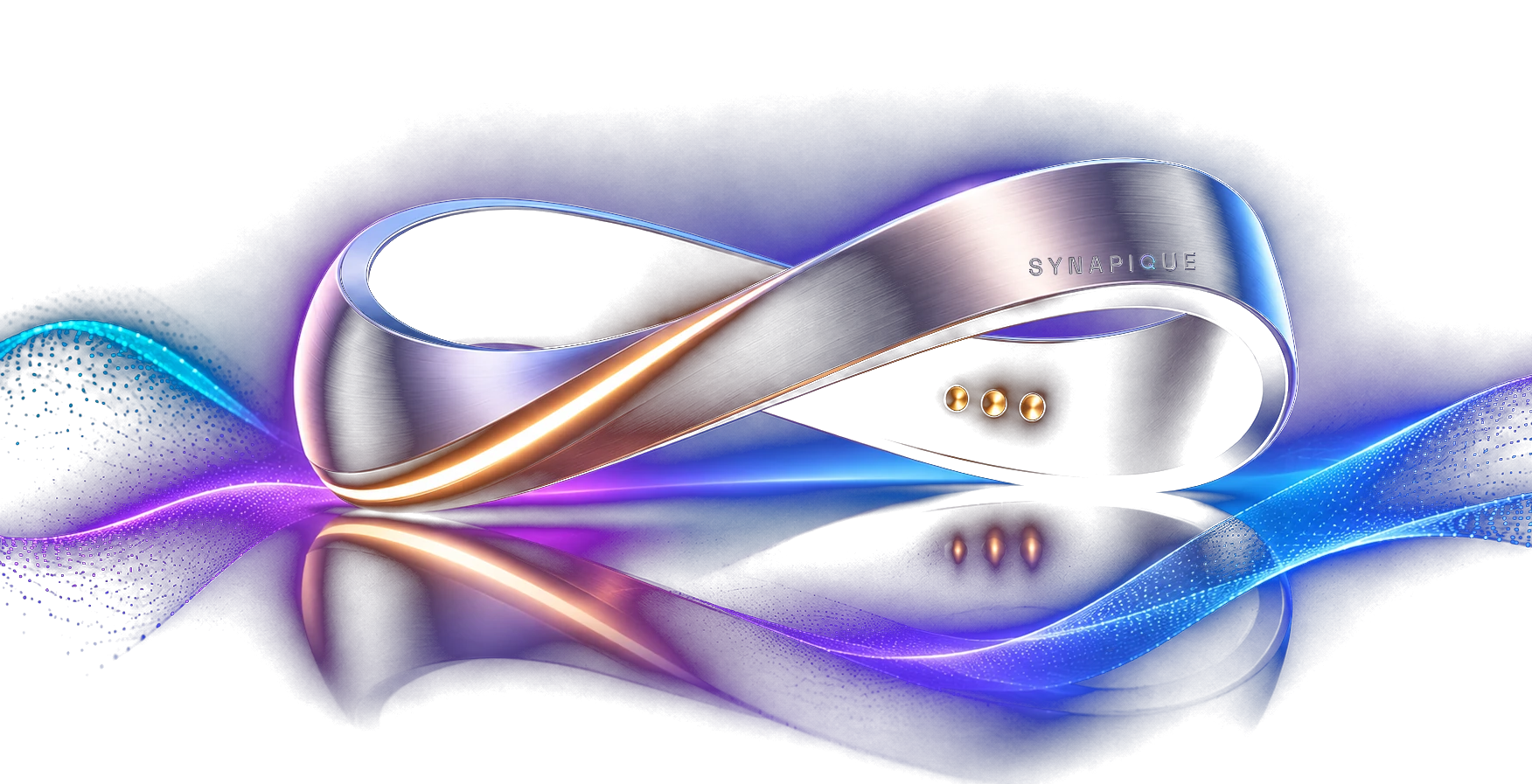
A new frontier
Human attention and cognitive performance are not static.
They fluctuate throughout the day in response to changing demands, environments, and individual circumstances.
We believe the next generation of neurotechnology deserves to be more responsive, personalized, and grounded in rigorous scientific investigation.
At Synapique Labs, we're exploring whether adaptive, noninvasive systems could offer new approaches to understanding and supporting cognitive performance.
The core problem: signals of interest are small and buried in blinks, movement and slow baseline drift. Separating them reliably outside a lab is unsolved.
Illustrative · synthetic signal · not recorded data
Our research direction
Exploring measurable physiological signals associated with attention, cognitive workload, and fatigue.
Investigating the scientific foundations and potential applications of personalized sensory stimulation.
Exploring whether physiological feedback could inform personalized interventions and improve measurable outcomes compared with fixed approaches.
These are proposed areas of investigation. None of these capabilities has been developed or validated.
Most conventional wearable experiences rely on predetermined interactions.
We're interested in investigating what becomes possible when sensing, interpretation, and intervention are studied as parts of an adaptive system.
Dry-contact electrophysiology
Exploring whether gel-free contact electrodes can capture usable physiological signals during everyday wear.
Designed for real life
Our long-term vision is to explore neurotechnology that fits naturally into everyday life.
We believe future wearable systems should prioritize comfort, discretion, accessibility, and user autonomy alongside scientific rigor.
We are interested in form factors that minimize disruption to daily activities while accommodating the sensing and intervention requirements established through research.
Open research questions
None of these are solved. They're the questions we believe must be answered before any adaptive neurotechnology could be responsibly built — and the ones we'd most like to explore with the right scientist.
Can meaningful physiological signals be separated from movement and muscle artifacts during ordinary daily activity?
What sensing-to-response latency would a noninvasive adaptive system need, and what safety boundaries must govern it?
How should a system account for person-to-person variability and baseline drift across hours, days, and contexts?
Which study designs and controls would be needed to rigorously test whether adaptation offers any benefit at all?
Building what comes next
Synapique Labs is in the earliest stage of scientific and technical exploration.
We're interested in connecting with researchers, engineers, and prospective founding collaborators who share our commitment to responsible, evidence-driven neurotechnology.
Areas of interest
For scientists
These are open conversations, not formal posted positions.
Interested in research collaboration, technical development, or learning more about Synapique Labs?
We'd welcome an introduction.